

Fastest in the world, Interpret Leukemia vectors within 7 seconds
Date: 2019-11-17
Sources: 自由時報
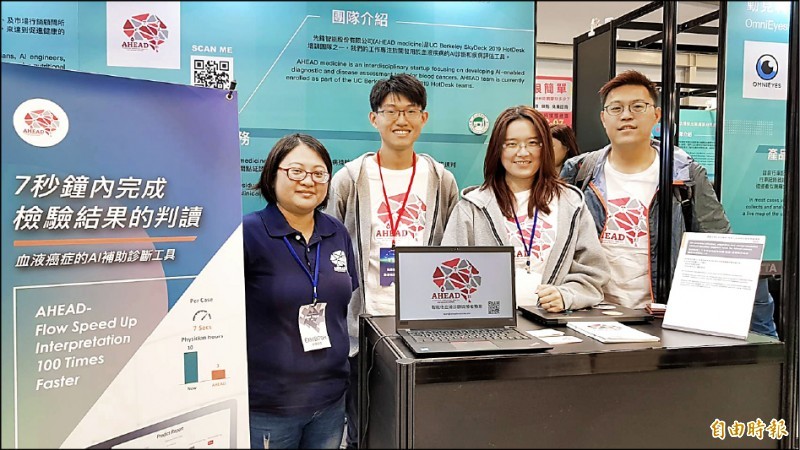
National Taiwan University Hospital and National Tsing Hua University Integrate AI and Clinical Data to Develop Diagnostic Aid Software
The Department of Internal Medicine of the National Taiwan University Hospital and the Department of Electrical Engineering of National Tsinghua University have combined artificial intelligence and clinical data of blood cancer to develop the world's fastest technology that can interpret leukemia vectors within seven seconds. It is expected to increase the survival rate of patients with leukemia after receiving treatment.
Cooperate with American Medical Center for clinical trials next year
Tang Ji- Lu and Ke Bo-Sheng, attending physicians of the Department of Hematology and Oncology, National Taiwan University Hospital, and Li Qi-Jun, associate professor of the Department of Electrical Engineering, National Tsinghua University, combined artificial intelligence and clinical data of leukemia patients to create AI intelligence that can interpret results in seven seconds System for blood diagnosis and prognosis.
Leukemia diagnosis requires integration of different clinical data
The research team will set up the company AHEAD next year. Co-founder Wang Yu-Chen said that the diagnosis of leukemia requires a comprehensive review of different types of tests, including the use of flow cytometry to detect the expression of cellular proteins, and the appearance of bone marrow smears to integrate different clinical data. For making the final decision, reading the test report of the flow cytometer takes most of the time.
Current interpretation takes 30 minutes. Report has to wait 7 days
Zhang Ting-Yu, a team member, said that flow cytometry is used to test cell specimens in patients' bone marrow or blood. Doctors need about 30 minutes for interpretation. In addition, due to limited interpretation manpower, patients generally need seven to fourteen days to obtain reports, but leukemia deteriorates rapidly, some patients may face death threats while waiting for reports.
Zhang Ting-Yu pointed out that the National Taiwan University Hospital team and the Department of Electrical Engineering of National Tsinghua University cooperated to use artificial intelligence combined with clinical data to develop diagnostic aid software. National Tsinghua University provided artificial intelligence technology, and National Taiwan University Hospital provided historical inspection data and trained the computer to learn to interpret the test results. Results are available in seconds, and patients can get reports one or two days faster, increasing patient survival after treatment.
Wang Yu-Chen pointed out that this is the world's fastest technology in interpreting flow cytometry. The team began research in 2017. This year, it won the support of the Ministry of Science and Technology's cost-effective plan to complete the user interface design. Led the team to the accelerator training at Berkeley in the United States, and had negotiated with the University of Pittsburgh Medical Center to conduct clinical trials together. It is expected that the company will be established next year and complete the clinical trials. It will pass FDA certification and be officially sold in 2121.