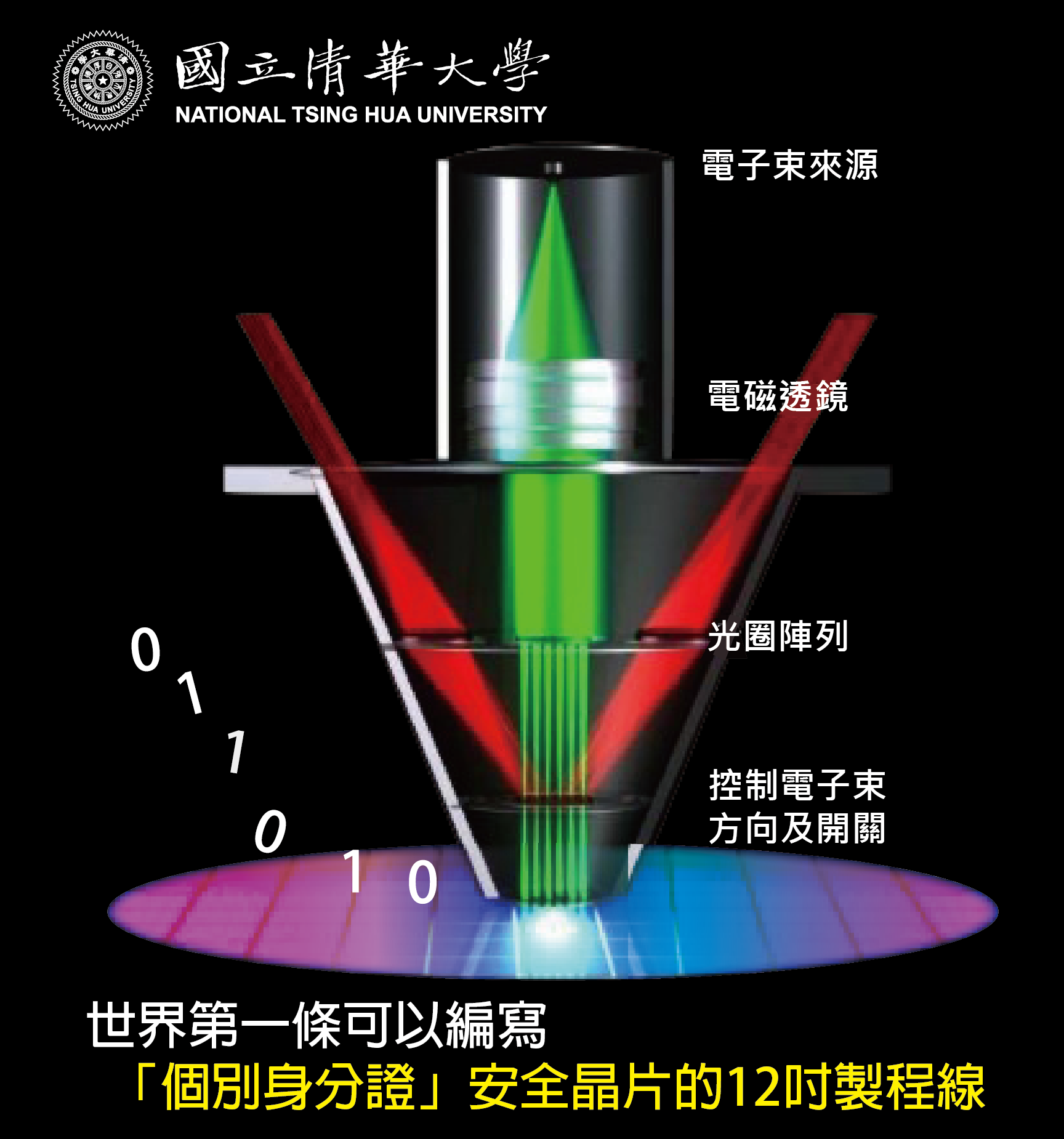

National Tsing Hua University established an international alliance to develop the world's first anti-hacker safety chip
The era of AI artificial intelligence is coming, from self-driving car, smart factories to personal mobile phones, electronic wearables and other chips that require higher levels of anti-hacker protection. National Tsing Hua University established the "International Association of Industry and Education", and today signed a contract with Mapper Microfilm Co., Ltd., an electron beam direct writing lithography equipment company. The world's second largest electron beam lithography equipment will soon be stationed in NTHU Laboratories to develop anti-hacker security chips with exclusive ID cards, and it will become an important support to NTHU's "Artificial Intelligence R&D Center".
Today's signing ceremony has made National Tsing Hua University the world's first university with 12 large-scale electron beam direct writing lithography semiconductor process research and development capabilities, at the same time, Taiwan has become the world's first country developing and trial producing the security chips with "identity card".
International Federation of Industry and Education, invites heroes from all walks of life
The Ministry of Science and Technology has established an international industry-university alliance with 15 universities across Taiwan. The Global Research & Industry Alliance (GLORIA), established at Tsinghua University, is based on the spirit of "smart life" and was launched in September last year. GLORIA had attracted foreign industry and academic research units to join the membership, share the information resources through the membership system, and put the latest scientific research into production.
NTHU’s R&D director Zeng Fan-Gen said that the Tsing Hua International Association of Industry and Education is like the martial arts ally. It invites heroes from all walks of life, education and research to come to Tsing Hua’s “Sword-play Contest” to discuss biomedicine, semiconductor, AI and Internet of Things, energy, and cultural innovation, the "martial arts" in the big field. In the first stage, 9 companies and the National Experimental Research Institute have joined the membership. For example, Delta is a VIP member; the general members include Haihua Electronics and Jinbao Electronics. It is also expected to introduce international-level multinational companies this year. In addition to the Tsinghua University, the academic circles have joined the Industry and Education Alliance with 9 schools including Donghai, Yuanzhi, Zhongyuan, Yuanpei, Zhonghua, Dahua, Mingxin, United University and China Medical University.
Lin Yu-Yong, chief operating officer of Tsing Hua International Academia-Industry Research Center, pointed out the rapid development in the industry, it is difficult to win alone. The Tsing Hua Academia-Industry Research Alliance first counts the research, patents, and talent pools of member universities and research institutes, invests in industrial cooperation and development, and then creating new revenues, new business models; participating students are also more advantageous in the job market in the future.
Massive electron beam direct writing lithography technology makes the anti-hacker chips possible
Today, the company that signed the contract with the Tsing Hua International Academia-Industry Research Alliance includes executive director of Mapper Microfilm(the world's only commercial large-volume electron beam direct-writing lithography equipment supplier - Bert Jan Kampherbeek from Netherlands), and supplier of lithography peripheral equipment-- Tadahiro Suhara, President of Japan Screen, and Li Ming-Zhe, Global Vice President of Synopsys and General Manager of Taiwan, who specializes in lithography software, jointly announced the 12-inch wafer giant electron beam direct writing lithography (MEB12) program officially Launched at National Tsing Hua University.
MEB12 project host, Professor Qiu Bo-Wen, director of the Nanotechnology, Material Science, and Microsystems Center of National Tsing Hua University, said that the current mainstream wafer processing is "optical lithography" using a photomask. It is like a camera, and it is very fast, but there is no unique code. It is easy to be hacked, and can only be encrypted with software at the back end; the wafer made by "electron beam lithography" technology is unique, but it is made to be "written" by mobile electron beam, which cannot keep up with the speed of mass production. The introduction of the huge amount of electron beam direct writing lithography technology has improved the speed of "writing" and solved the dilemma of mass production.
Qiu Bo-Wen said that "the huge amount of electron beam direct writing lithography technology" was not commercialized until this year. The first set of equipment was in the US Department of Defense, and the second set of equipment was settled in Tsinghua. He explained that the past electron beam is like writing a wafer with only one pen, but the "large amount of electron beam" is like having 650,000 pens written and coded on a nail-sized wafer at the same time, which overcomes the fast production speed. The problem. "Direct write" means that the electron beam is directly written on the wafer without refraction through the mask, which saves the cost of the mask of hundreds of millions of dollars.
Tsinghua Artificial Intelligence R&D Center Offers all kinds of AI courses
Looking at the wave of AI artificial intelligence, National Tsing Hua University also established an artificial intelligence R&D center today. The Tsinghua Artificial Intelligence R&D Center covers a total of 18 departments in 8 colleges. In addition to the fields of computer science, the most special ones are scholars from the humanities and social fields such as neuroscience and linguistics, anthropology, etc., to promote AI research and study.
Zhang Shi-Jie, deputy research and development director who is also the director of Tsinghua Artificial Intelligence R&D Center, said that in the past six months, he has received many calls from industry and alumni, they hope to visit AI courses through National Tsing Hua University, or want to form a study club, and even manufacturers ssk directly if the school have an AI project that they can buy. National Tsing Hua University has established an artificial intelligence R&D center, which will serve as a contact window and cooperation platform for the school's AI field. It will integrate the inter-disciplinary resources of the school, and develop an AI course integrating science and technology, philosophy, medicine, law, and ethics, and hold occasional lectures to meet the needs of the talents in the next generation.